Monday, October 24, 2022

Memories Dreams Reflections 8: The Play


When it comes to preserving memories, the human brain is an arbitrary antiquarian. It’s amazing how the most trivial things stick in the mind, and how some very important memories we lose. For example, one nonsensical thing I can remember is the lyrics to “Have You Seen the Ghost of John,” a song we used to have to sing during music classes at Bernon Heights Elementary School, a song whose lyrics I’ve always associated with Halloween:

“Have you seen the ghost of John?
All white bones with the skin all gone
Oooh, Oh Oh Oh Oh Oh
Wouldn’t it be chilly with no skin on?”

One of the things I liked about the grade school I went to was how they would decorate each classroom to reflect the current season. So during the fall months, you would see multi-coloured cardboard leaves and Jack-o’-Lanterns cut from orange construction paper lining the walls. Room 2, which was my classroom at Bernon Heights Elementary School in the 4th grade, was no different in this regard. And I can still vividly remember the day when our teacher, Miss Lamansky, announced to the class that our classroom would be staging a Halloween play towards the end of October. She then handed out to each of us photocopied and stapled copies of the play, which I shall now take it upon myself to describe.


The name of the play was The Case of the Giggling Goblin, and it was written by a woman named Helen Louise Miller. It was a one act play, only 7 pages long, and it was included in the book Short Plays for Children: a Collection of Royalty-Free Comedies, Mysteries, Folk Tales, and Holiday Plays for Boys and Girls (Boston Plays, Inc., 1969), which was a collection of 24 plays. The setting of the play is Judge Jack-o’-Lantern’s underground court room, in the abandoned Bloody Bones Mine, which is part of a community of monsters and ghouls that collectively is known as Hauntsville. In this court room, an informal hearing is taking place. Gladys Goblin, the daughter of Mr. and Mrs. Gorgon Goblin, has been deemed a nuisance to the citizens of Hauntsville due to her incessant giggling. A number of citizens are called to make statements, including Gladys’ parents, Dr. Spook (author of a book on goblin guidance, who claims that Gladys is suffering from giggilia nervosa, or nervous giggles), Olga Ogre (Gladys’ teacher), the Phantom of the Opera, Dr. Dracula, Damon Demon (a reporter for the Hauntsville Happenings newspaper), and Harry Haunt (the newspaper’s photographer). Other characters include the Judge’s deputies, Captain Cornstalk and Sargent Scarecrow (remember, this is a play for little children). Towards the end of the play, two human beings invade the mine, causing the citizens of Hauntsville to go into hiding (which makes them pretty piss-poor monsters, really). The humans are treasure hunters, with plans to dynamite the mines in search of gold. However, they’re scared away by Gladys’ ghostly giggling. The citizens of Hauntsville proclaim Gladys as their “Halloween heroine,” and the play ends with everyone chanting “Hurray for Gladys the Giggling Goblin.” And…. Curtain.

There are a total of 26 characters in the play, some more important than others (Judge Jack-o’-Lantern and Gladys are pretty much the two main characters, while the eight Hobgoblins only get one line apiece). Miss Lamansky began taking volunteers for each role. When it got to be my turn, I decided to go with Dr. Dracula, the court physician, who speaks a total of 4 times in the play. Being the introvert that I am, I’m unsure why I didn’t just volunteer to play as one of the Hobgoblins. But something about the role of Dr. Dracula seemed to be calling to me. Perhaps because the character was a vampire, and I had a fascination with vampires. As you can imagine, there’s a story behind that, and it can all be traced to an obscure video game, the Intellivision Dracula game I mentioned back in the 6th entry of this series. 

The date of the performance of the play was set to October 17th, 1989: a Tuesday (I myself was born on a Tuesday, for the curious). In the weeks leading up to the play, my mother began fashioning for me a vampire costume (which would later double for my Halloween costume for that year, when we went trick or treating 2 weeks later), while I set about memorizing my lines. Luckily, I didn’t have all that many to learn, and my memory has always been pretty good anyway. Our class also began rehearsals for the play, which were pretty dull.

Meanwhile, starting around the first of October, a poster began appearing on the walls of the corridors of Bernon Heights Elementary School. This poster was a golden yellow color, and it depicted a black and white illustration of a cheerfully smiling ghost emanating forth from the top of an equally cheerful-looking Jack-o’-Lantern. Words were typed out in black letters on the body of the ghost, and this is what the letters spelled out:

 WORTH HAUNTING FOR!

ATTENTION PARENTS OF 3rd & 4th GRADERS

On October 17 the PTO will sponsor its first

monthly event from 7-8:30 P.M.

Miss Lamansky's 4th gr. Class will present

“The Giggling Goblin”

Followed by a Halloween flick

Treat bags will be handed out at the door.

In order to keep the cost of the evening

down we ask that each family bring some

dessert to the event, ie. brownies, cookies.

We hope to see you there!!

Thanks for your cooperation!


Unfortunately, I can’t remember what the “Halloween flick” that they showed after the play was.

As previously mentioned, the one and only performance of my 4th grade class’ staging of The Case of the Giggling Goblin took place on October 17th, 1989, in the school cafeteria/auditorium. And here I have a bit of a confession to make: even though this entry has been culminating towards this moment I actually don’t have a great deal to say about the actual performance of the play, simply because, for whatever reason, I don’t remember a great deal about that night. Ironic, no? As stated earlier, I can’t remember which movie it was that was shown after the play was done. I can’t remember the name of the girl who acted as the star of the play. I don't remember how the stage was dressed. I can barely even remember what it was like to act in front of a large crowd of people. I’m sure that my parents recorded it all on their camcorder at the time and that footage exists on some moldering VHS cassette tape somewhere, though I have no idea where that is (hell, we don’t even have a VHS player anymore). So all I can do is tell you what I do remember.

My costume, for example, the one that my mom made for me in the days leading up to the play (it helps that I have a picture of it, I suppose). I remember I was wearing a long black cape (with a red velvet lining) over a white dress shirt and black vest combo, plus black dress pants and black dress shoes, and I was also wearing some type of gold medallion around my neck (with a fake red jewel in the center). Some white corpse face paint/make-up was applied to make my skin look paler (probably not really necessary as I pretty much always look very pale anyway), and black make-up was smeared along the tops and bottoms of my eyes. I forget if I was wearing plastic fangs or not: I think I may have tried those out at first, but they may have made saying my lines too hard, so I probably went without them. I also had a prop: a black medical bag, inside of which was one of those rubber skeleton toys you can buy at any convenience store around Halloween time. 

I remember that during the play itself I was standing stage left, not far from the wings. The play was 7 pages long, and my role kicked in at the end of page 4 (and stretched to around the start of page 5). When the Judge called me forward, I strode to the stand carrying my medical bag and delivered my first line: “I have reason to believe, Your Honor, that the case of the Giggling Goblin can be cured.” I must have been mumbling my lines at first, because when I looked out into the audience, at that sea of expectant faces, I remember spotting Ms. Lamansky in the front row, mouthing the word “louder” to me, so from then on I began to speak in a louder voice. When the Judge asked me to explain my theory, I said, “It’s very simple. Remove the giggle and the cure will follow.” I then reached into my medical bag and pulled out the rubber skeleton prop. As one of the other actors held the skeleton up, I used a pointer as I spoke to demonstrate my vampire’s medical theory, and I said the following lines: “If Captain Cornstalk will assist me, I will demonstrate… Now, Miss Goblin says the tickling starts here and proceeds upward through the lungs and laugh canal until it reaches the oral cavity, where it explodes into a giggle. Obviously, if we remove the giggle and block the laugh canal, her problem will be solved.” As the Giggling Goblin pleads that she’d rather be shut up in a dungeon then never laugh again, the Judge opines that Dr. Dracula’s treatment seems a bit drastic. I then delivered my big line: the play noted this line should be said dramatically, so in a haughty and dramatic voice I said, “To remove a giggle would make medical history.” The Judge then dismissed Dr. Dracula, so I replaced my medical equipment into my bag and walked back to my spot at stage left. And that was pretty much the extent of my role in The Case of the Giggling Goblin.

The Case of the Giggling Goblin wasn’t my final experience as an actor. During the 5th grade, in the years 1990-1991 (my last year at Bernon Heights Elementary School), I took part in another one act play, Old King Cole’s Christmas. This was a much more low-key production (in that it was only performed in front of my fifth grade classroom rather than the whole school), though in this one I played the lead role, King Cole himself. I should stress here that I certainly didn’t want to play such a big part, but that my teacher handpicked me for the role, so I didn’t really have a choice. I found this experience so unpleasant that afterwards I resolved to never act again. And true to my resolve, I didn’t. It would seem that the world of Or was not for me. The World of Er, on the other hand, had just begun to open its gates...


Sunday, October 16, 2022

Memories Dreams Reflections 7: School Library & Books

Of all the rooms at Bernon Heights Elementary School, my favorite by far was the library. As I mentioned in an earlier post, the library was located in the northeast corner of the long hall that ran along the front of the school, not far from the doors that led into the cafeteria. The library was a long and narrow room, shaped like a horizontal rectangle, with the door leading into it located on the south corner of the room’s west wall. To an adult such a room might feel cramped, but when I was a child the place seemed as airy to me as the Library of Alexandria. Upon entering the library, I would usually head straight to the western corner of the north wall, for there, on one of the lower shelves, was the library’s collection of the Crestwood House Monsters book series (always easy to spot thanks to their distinctive Halloween-orange spines).

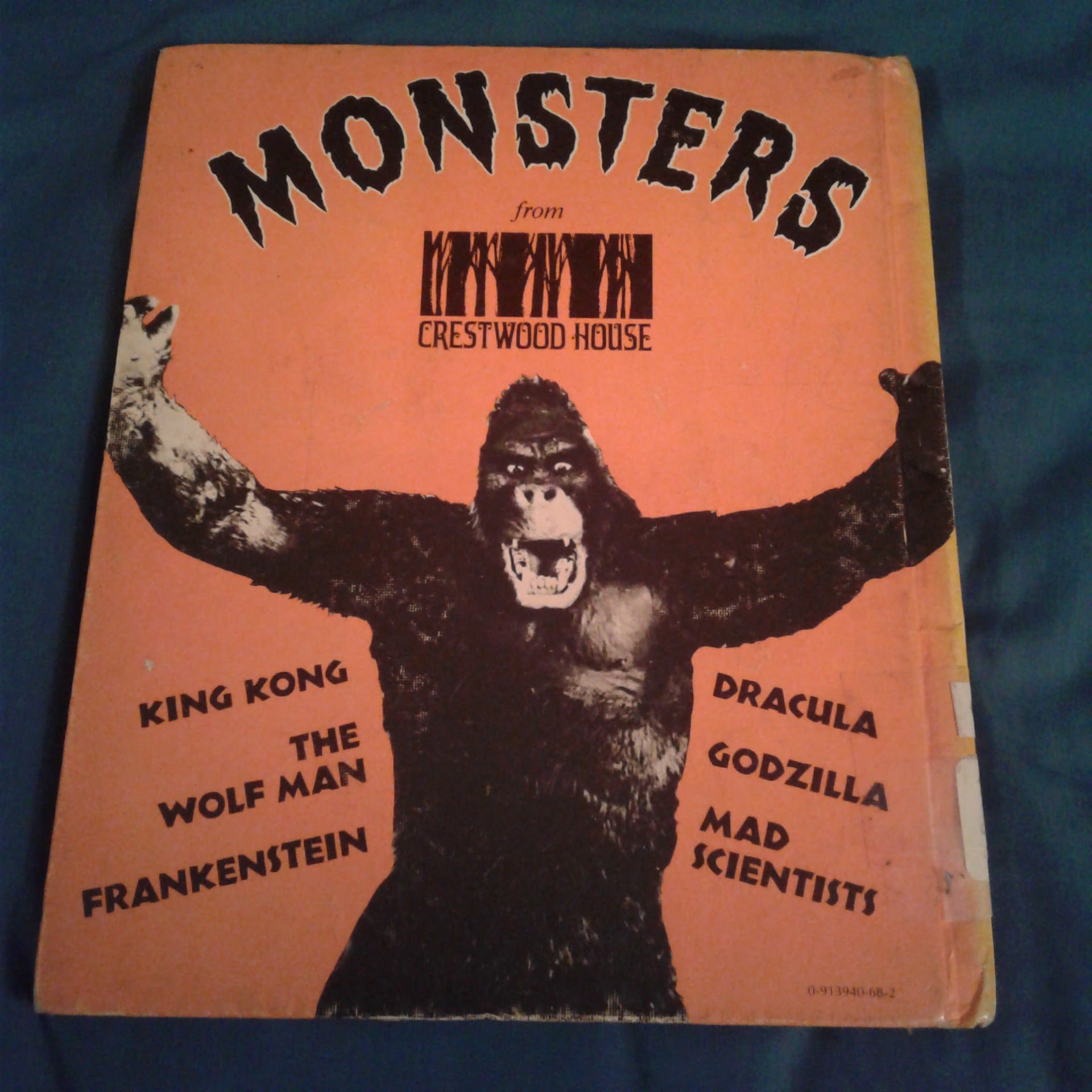
I suppose I should talk a bit about the Crestwood House Monsters series. This was a series of hardback books released in the late 1970’s (and later reprinted in 1982) that revolved around classic movie monsters. The books had a very striking design: a black and white cover that featured the monster in question and their name in bold orange colors, with a deep orange spine and an orange back cover (with the text on the spine and back cover being in black). On the back cover one could find the word MONSTERS in big black all-caps letters, and beneath that was the publisher’s logo and a list of all of the titles in the series (beneath this list was a black and white King Kong with outstretched arms). These books were credited to Ian Thorne, which was a pseudonym for the science fiction writer Julian Clare May, but their actual authorship is, as far as I know, unknown. Each of the books in the series was around 50 pages long, and full of information on the monster and their various film appearances, all illustrated with striking black and white photographs. The titles in the series were The Invisible Man, The Deadly Mantis, It Came From Outer Space, The Phantom of the Opera, Frankenstein Meets Wolfman, The Murders in the Rue Morgue, The Creature from the Black Lagoon, The Wolfman, The Mummy, Godzilla, The Blob, Mad Scientists, Frankenstein, King Kong, and Dracula. I forget if the Bernon Heights library had the complete set… I don’t believe so as I don’t recall ever reading ones like The Deadly Mantis. Of the many books in the library, these monster books were my favorite, and I was always taking them out to read at home. Godzilla, obviously, was my favorite of the bunch, but I also quite enjoyed The Blob and Dracula as well. This year I finally purchased for my own collection a used copy of the Godzilla book.


Those interested in reading more details on the Crestwood House Monster Series should check out the following link: http://sickopsychotic.blogspot.com/2013/04/crestwood-house-monsters-series.html

As for Dracula (a book I consulted when doing research for the role of a vampire that I was to act out in a school play), the Crestwood book had a very atmospheric photograph of Bela Lugosi posing as the Count on the cover (from the 1931 American Dracula movie), and though I enjoyed reading this book as well, I would not actually see the Lugosi version of the film until the year 1999, during my second year of college, when I became involved in the Goth subculture. But to get back to the Dracula book. It began with a lengthy description of the 1931 Dracula film, followed by some information on Bram Stoker and how he wrote the original novel, biographical details on Vlad the Impaler and Elizabeth Bathory, a map of Transylvania, a photograph of a real-life vampire bat, and briefer descriptions of some of the other Dracula spin-offs and remake films, including Nosferatu, the Christopher Lee Hammer Horror movies, even Blacula. This book also gave some details on what vampires actually were: undead monsters that rose from their coffins to feast on human blood, fanged reflection-less creatures capable of turning into bats, that could be repelled by both garlic or a cross and which could only be killed either by exposure to daylight or driving a stake through their heart.

Another book I consulted for research purposes was Gary Jennings’ Black Magic, White Magic (The Dial Press, 1964), an introduction to occultism written for younger readers (what my school library was doing with a copy of this book I have no idea). This book also had some information on vampires. Here’s a direct quote: “The vampire was thought to be a corpse who refused to stay dead, continuing to roam the earth. To sustain this unnatural animation, it had to have human blood, which it drew from unsuspecting sleepers. In some versions of the legend, the bite of a vampire could turn the bitten one into a vampire, too.” It went on to say that Transylvania wasn’t the only location on Earth that had vampire legends, but that many other countries had vampire legends of their own (for example, the ancient Babylonians feared a vampire-like creature known as the Akhkharu). Interestingly enough, on page 51 of this book there was an illustration of a pentagram, and an explanation about how, when the pentagram was right-side up, it was a powerful protection against the forces of evil, but when it was pointed downward, the symbol represented Satan and was used to invoke evil spirits. My friend J was also a big admirer of this book, and it’s no doubt that it was within its pages that he came up with the idea to draw pentagrams on the palm of my hands to protect me from his lupine ambitions: though evidently he had read the book wrong, what with him drawing upside-down pentagrams on my hands instead (unless his intentions were more malicious than I’m giving him credit for… and with J, who knows? But that's a tale for another day...)

Despite my many happy memories of hours spent at the Bernon Heights Elementary School library, I do have some bad memories as well. Towards the back of the library, near the south corner of the east wall, were a number of magazines and periodicals, and some days when I was bored I would flip through these. Boy’s Life was one that I especially seemed to enjoy. In September 1990, the month I began the 5th grade, I was flipping through the August 1990 issue of that magazine. I’m not sure what the magazine’s like now but back then each issue had a one page comic chronicling the real-life exploits of Boy Scouts whose heroic actions saved the life of another: “A True Story of Scouts in Action” was the name of this feature. In the August 1990 entry, the story depicted in the comic is set in Utah and revolves around a 49 year-old man named Ted Phillips. On August 17th, 1988, Ted was awoken by a sound at 4:30 AM. Thinking it was one of his children, he went downstairs to investigate the noise. Upon reaching the first floor of his house, an intruder suddenly appeared, swinging a big hunting knife. As Ted was stabbed, he yelled out to his wife to “get the gun!” The intruder then dropped the hunting knife and ran away from the house. While the mother called the police, Ted’s 14 year-old son, Scott, administered first-aid to his father, who was bleeding. Luckily, he wasn’t hurt too badly and survived the encounter.


I’m not sure why, but something terrified me about this story as a kid. Partly it’s due to the scenario of the story, which is itself an contrivance of horror (in that someone’s reality is invaded by an agent of irrationality, violence, chaos and unreality): it was a situation I could easily visualize happening to myself, and the fact that the ‘Intruder’ is never named, has no speaking lines or any established motive for why he’s breaking into someone’s house and stabbing strangers in the dark (and by the end of the comic still remains at large) doesn’t help matters. But I think what I found especially unnerving about this comic (which, when I looked back on it in January of 2016, seemed somewhat tame) is how the ‘Intruder’ was drawn: shadowy, seemingly bleached of most colors, with weird lines running vertically not only down his clothes but also his face (perhaps drawn by the illustrator to suggest shadows). And what was that thing atop his head supposed to be: hair, some kind of hat, maybe a ski-mask he had forgotten to cover his face with? 

Anyway, it’s funny how this image, which I saw for only a few minutes on one day of my life as a child, haunted my mind for years. It was even more interesting for me to see it again (over 25 or so years later) and see what I both remembered (and misremembered) about the scene. In my memory of the comic, the scenario went like this: late at night, the father hears a knock at the door. He goes to answer it, and on the other side of the screen door is the ‘Intruder,’ who stabs him with a knife before vanishing into the night. Obviously I got some of the key details right (a father being stabbed with a knife in his house late at night by a stranger) but some of the other details wrong (the stranger never knocked at the door, and it wasn’t a screen door, but a sliding one). I see also that I totally misremembered how the Intruder looked: I thought we saw his visage from his front profile, not his side. But one thing I did remember correctly was how he appeared to look somewhat gray and had lines running all along his body. That I remembered accurately.

While on the subject, now might be a good time to talk about some of the other books I enjoyed reading as a kid. Unsurprisingly I was a fan of some of the standards, such as the Berenstain Bears, Babar the Elephant (especially Babar and Zephir; I loved the horned monster Polomoche and his fellow beasts the Gogottes. Also worth checking out is Babar and Father Christmas, which has a stunning two-page illustration of Father Christmas’ sprawling and cozy  underground home/workshops), Dr. Seuss’ work, and Roger Hargreave’s Mr. Men series (if I remember correctly, my two favorite characters from that latter series were Mr. Bump and Mr. Daydream… maybe Mr. Dizzy as well). There was also the Wayside School books written by Louis Sacher, James Howe’s Bunnicula series (Chester the Cat being my favorite character from those), Nancy McArthur’s The Mystery of the Plant That Ate Dirty Socks, Daniel Pinkwater’s Lizard Music, Gary Poole’s Movie Monsters (Modern Publishers, 1986), Richard Meyer’s The Great Science Fiction Films (Citadel Press, 1984), Christopher Finch’s The Making of the Dark Crystal (Holt, Rinehart & Winston, 1983), The Star Wars Storybook (Random House, 1978), Ten Great Mysteries of Edgar Allan Poe (Scholastic Books, 1989… though I must confess I was a little creeped out by the sinister illustration of Poe’s face on the front cover), and so on and so forth. The Johnny Dixon horror mysteries by John Bellairs were also books I loved, though I didn’t start to read those until around the 5th grade, the first of which was The Spell of the Sorcerer’s Skull. And who could forget Bruce Carter’s 1977 novel Buzzbugs, with its striking cover art featuring two people, a man and a woman, running up a hill and trying to escape from a mosquito the size of a whale?


One of my favorite books from that era was Roald Dahl’s James and the Giant Peach. I discovered that book when one of my grade school teachers read it to our class, a few chapters every day. I forget if that was the 2nd grade or the 3rd grade… most likely the 3rd grade, so probably around 1987-1988. After she had finished reading the book to us I managed to get a copy of my own, with beautiful illustrations by Nancy Ekholm Burkert. Something about that book just captivated my imagination, and like the little boy in the book I too wanted to live inside that giant peach, surrounded by those big fantastic talking bugs (the Centipede being my favorite).

However, by far my most beloved books when I was a child were the two Alice books written by Lewis Carroll, Alice’s Adventures in Wonderland and Through the Looking-Glass. The edition I owned (put out by Watermill Press in 1983) collected both volumes, though many of the illustrations by John Tenniel were not included (I believe they only had one per chapter). I first read the book in 1986, the same year that the aforementioned Commodore 64 game was released, though I can’t remember if I played the game first or read the book first… no matter what, one of them inspired me to investigate the other. To this date I still enjoy re-reading the Alice books every few years. My two favorite characters from the first Alice book were the Cheshire Cat (big surprise there) and the Gryphon. It’s perhaps no surprise that since reading that book the griffin remains one of my favorite mythological hybrid creatures. But seeing as I hope to do a whole separate post on the Alice books at some future point, for now I will say no more on this topic. 

Friday, October 14, 2022

Memories Dreams Reflections 6: Video Games (1980's edition)

Initially my family owned two gaming platforms: a Commodore 64 computer and an Intellivision console (it wouldn’t be until around 1986 or 1987 that we got a Nintendo Entertainment System). I really loved a lot of the games that one could play on those old systems. One of my very favorite Intellivision games was Dracula, which was released by Imagic in 1982. Essentially a horror side-scrolling video game programmed by Alan Smith (with graphics assistance from Wilfredo Aguilar and sound design by Dave Durran), the setting is a modern city (presumably London), and you play as a vampire (somewhat unoriginally named Dracula). At the start of each night, you see Dracula rise from his coffin in the graveyard, turn into a vampire bat, and fly to the city street, where he turns into his human form and begins his search for victims.

The goal of each stage (or “night”) is to drain the blood of a certain amount of victims, then return to the graveyard before sunrise. There are two types of victims: those that are just wandering around the street and those who hide in their houses (you know a house has a victim if you can see a pair of eyes in the window above the door). Killing the victims wandering the streets is pretty easy: it’s just a matter of maneuvering Dracula so that you bite the back of the victim’s neck (this causes the victim to vanish, which earns you 50 points). To get to the victims hiding indoors, you need to go up to the door of their house and knock on it. If you killed a victim in sight of their window, they won’t come out: otherwise they’ll race out of their house quickly, temporarily stunning you and forcing you to chase after them. At the bottom of the screen are a number of icons representing your score, the number of remaining victims left to drain, the current time of night, and Dracula’s blood level. Once the goal of victims has been reached, you move Dracula back to the graveyard, where he turns into a bat, flies back into his coffin, and goes to sleep.

Of course, there are certain adversaries to avoid. One such adversary is the white wolf, who appears once you’ve hit your goal of victims. The wolf can’t kill Dracula, but if he bites you, it slows you down. To avoid it, you can turn into a vampire bat and fly away, but this also makes you vulnerable to another enemy, the purple vulture. The vulture only appears when you’re in vampire bat form. If it grabs you, it tries to carry you off the screen, and you must quickly turn back into human form. Finally, there’s the constable, who only appears in certain stages. He’s a cop who will chase after you, hurling wooden stakes at you. If one of these stakes hits you, it temporarily freezes you in place, costing you precious time. Dracula himself can’t kill the constable: if you bite him, it only temporarily paralyzes him. What you can do instead is turn victims into zombies. When you turn a victim into a zombie, the zombie is controlled by the second controller (which is why it helps to play this game with two people), and you have ten seconds to touch the constable with the zombie: doing so will make the constable vanish, earning you 75 points (and once the 10 seconds are up the zombie vanishes as well, gaining you another 50 points).

In Dracula you only have one life: lose it and its game over. There are three ways to lose the game. The first is to not get back to your coffin before sunrise (each stage begins at 12:00 AM and you have until 6 AM to finish up your tasks: you know you’re almost out of time when the sky turns pink at 5 AM). The second way to lose is if the vulture snatches you in the vampire bat form and succeeds in carrying you off the screen. The third way to lose is if Dracula runs out of blood. As you play each stage, your movements gradually lower your blood supply: flying around in the vampire bat form causes you to lose blood more quickly, so there’s a trade-off there. When Dracula’s blood is very low, he turns completely white. To replenish your blood supply, you need simply to bite more victims.

As one can probably infer from the above description, Dracula can be a somewhat repetitious game, but still a stylish and fun one. The graphics, for their time, are very good (it’s cool how the sky changes color over the course of the night), and there are some neat effects, like flashes of lightning followed by thunder. Dracula himself looks impressive, and the minimal electronic music is suitably funereal. And it's one of the first video games I ever encountered that let you play as the bad guy! 


There were other Intellivision games I enjoyed playing, like Burger Time and Shark Attack (you can probably guess why I liked playing Shark Attack). And there were just as many games I adored for the Commodore 64. To name just a few: Below the Root and Alice in Wonderland, the two games that Dale Disharoon created for Windham Classics in 1984 and 1985 (if you ever want to see a thing of beauty, do a Google Image Search for “Below the Root Map”). Archon: The Light and the Dark (1983) was always great fun, especially with two players; I would often play with my dad, and in our games I almost always played as the dark side… I just found their pieces cooler, a monstrous menagerie of dragons, manticores, basilisks, banshees, shapeshifters, and other exotic beasts. Maybe I'll say more about some of these games (especially the Windham Classics ones) at some later date, but because it's October, right now I'd rather focus on the monster games. 


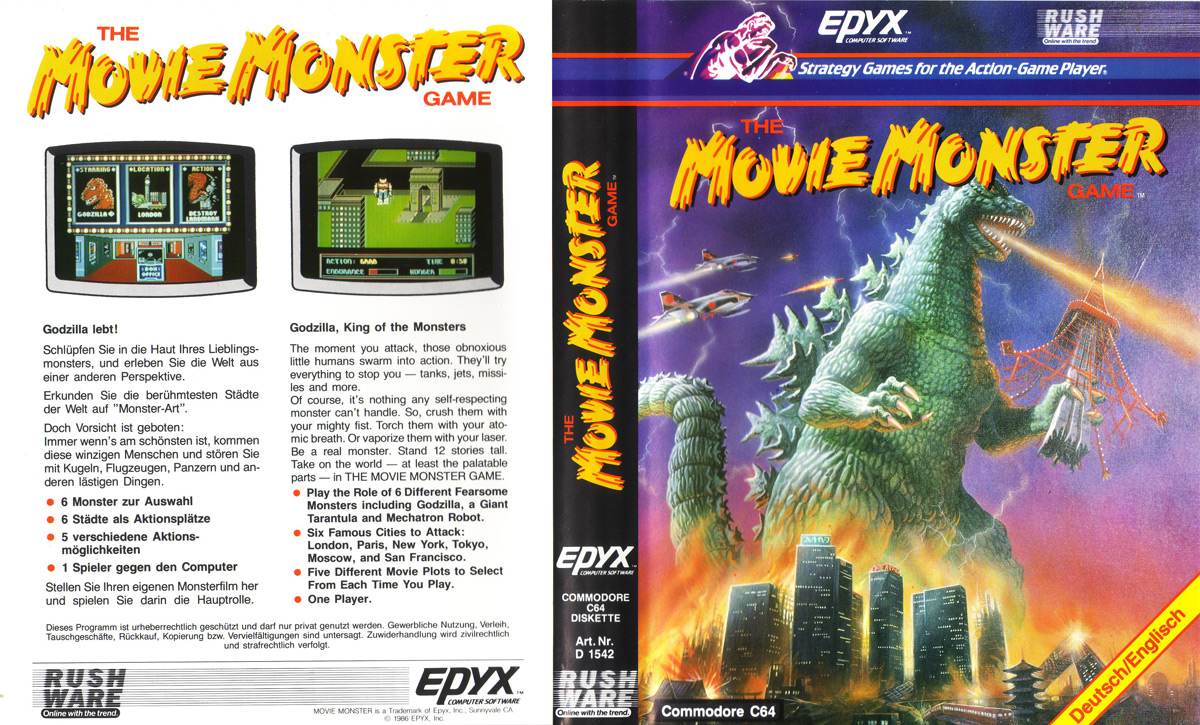
Speaking of which:  one of my favorite games to play as a child was The Movie Monster Game, a single-player game released by Epyx for the Commodore 64 in 1986. Designed by Jon Leupp, the game’s main appeal to me was that (like Dracula) you got to play as the monster; when I saw the game in a computer store in 1986, with its box art featuring Godzilla breathing fire and clutching the remains of the Eiffel Tower in his left claws, I just knew that this was a game I had to own, and I convinced my dad to buy it for me. The game’s gimmick was that you were put in charge of designing your very own monster movie: first coming up with the basic scenario, then actually getting to play it. After the game’s title screen loaded up, you were shown the marquee of a movie theater, with three boxes above it: the first box is labeled STARRING, the second is labeled LOCATION, and the third is labeled ACTION. This screen is where you choose the details of your monster movie. First, in the STARRING box, you select which monster you want to play as. There were six options here: Godzilla (the only actual movie monster the game was able to get a license for), Sphectra (a giant wasp), the Glog (a huge green glob with eyes and a mouth, obviously inspired by The Blob), Tarantus (an enormous tarantula), Mr. Meringue (a rip-off of the Stay Puft Marshmallow Man from Ghostbusters), and Mechatron (a gigantic robot). Next, you had to select your location, which would be the setting for the “film,” and these settings were New York City, San Francisco, London, Tokyo, Moscow, and Paris. Finally, you needed to select the ACTION for the “film,” which served as the plot in a manner of speaking. The five actions to choose from were “Lunch” (which involved eating as many humans and vehicles as you could until your hunger meter was full), “Destroy Landmark” (which involved destroying a certain landmark in whatever city it was that you chose), “Search” (perhaps the most difficult action, in that it involved trying to find your monster’s captive offspring: I only ever beat this scenario once, using Sphectra), “Escape” (the easiest action, it simply involved you getting your monster out of the city), and (my favorite) “Berserk” (which involved causing as much mayhem and destruction as you could until a certain point goal had been reached, after which you needed to escape from the city with your life).

After setting up the film to your personal specifications, you next see a scene that depicts a movie theater, with an audience staring at a movie screen that is obscured from view by curtains. The curtains slowly rise to reveal the screen, and then the previews begin. Like any decent movie theater, they advertise the snacks you can buy (if this game would be made today, there’d probably be an additional screen telling people to turn off their cell phones); along with the generic popcorn they also hawk “Gummi Glogs”, which is a nice touch of humor. This ad is followed by a green preview screen that lets you know what the following movie is rated. Only in this case, the “G” rating is for “Gamers of all Ages”. What comes next is simply brilliant. The game gives you previews of some of the then current games that Epyx had released: Summer Games 1 & 2, Super Cycle, Winter Games, World Karate Championship, and World Games. An apt presentation of movie previews and at the same time a sly example of in-game advertising, very postmodern and metafictional, that. Finally, it’s time for the “Feature Presentation”. What follows is 3-4 screens of text that set the game up. The text varies depending on what type of game you selected to play, what monster and city you chose, and so on. The text is quite well-written for an 80’s game and really sets the mood for what’s to come.

Following this introduction, the actual gameplay segment kicks in. On the game screen you basically see your chosen monster standing in the center of the city you selected. The status bar that takes up the bottom portion of the screen tells you four things: the currently selected action for your monster, its endurance level (essentially its life bar), how much time has elapsed since you started playing, and your score, which goes up with each act of destruction and mayhem you commit. Most games are over by the five minute mark: I’ve never seen one go up to ten minutes or more. One of the only flaws of the game, actually… it’s fun to destroy the cities but like most fun things it’s over all too quickly. Each monster has a set of three actions, with the exceptions of the Glog and Sphectra. They can all scream (the purpose of which is used to find the monster’s child if you’re playing “Search”), all can send atomic energy blasts upwards to destroy overhead planes or helicopters, and each one has a third “special” attack unique to their character. Generally, you destroy buildings by bashing your monster against them over and over again until they topple (with Godzilla, it usually takes about 3 bumps to knock a building down). The only problem with this is your monster takes damage in the process. As if that wasn’t enough, eventually the army will start attacking you with little green civilians (army men), tanks, jeeps, jet planes, helicopters, and navy boats. Most of their vehicles are much quicker than you and can rapidly drain your life (most of the monsters, like Godzilla, are very slow). There are ways to replenish a bit of your life though, namely by eating civilians. Not all the cars and citizens you encounter can hurt you. Most vehicles, like taxis, cars and ambulances, are harmless, as are the regular citizens (who are represented as tiny white dots). The regular citizens run away from you, but if you eat them (by walking over them) you’ll gain back a bit of life. They seem pretty scarce sometimes, though.

So that’s basically the game: move your monster around, smash things, cause chaos. Sadly, though, all good things must come to an end. If you’re good enough, after causing enough carnage you can escape the city, but more often than not your endurance bar runs out and its game over. No matter if you win or lose, at the end of the game you return back to the end of the film in the movie theater, where you receive a summation of your monster’s actions and an evaluation of how much damage you did (if you score over 1000 points a national emergency is declared). Then you are given a final score, and this is followed by the end credits, which is a list of all the people who helped make the game. Then you’re booted back to the lobby, and you can start a new game. One thing that gives the game a lot of replay value is that, with its six monsters, six cities and 5 scenarios, you essentially get 180 different permutations. And each monster has its own strengths and weaknesses and different styles of play. For instant, Godzilla can breathe radioactive fire and is the strongest monster, but he’s also the slowest. Sphectra has a sonic weapon and, being the only monster capable of flight, is also the fastest, but he’s also the weakest and drowns in water. The Glog has top endurance and a corrosive touch, but only average strength. Tarantus can shoot webs and is the second fastest monster, but like the Glog his strength is only average. Mr. Meringue can spit out globs of meringue and is fairly strong (he also recovers his health pretty quickly), but he’s also slow and floats uncontrollably in water. Finally, Mechatron is very powerful and has a laser weapon attack, but his endurance meter is incapable of recovering and he can’t touch the water. As a kid, I tended to gravitate towards playing as Godzilla, though Mr. Meringue was a favorite as well, as he reminded me so much of the Stay Puft Marshmallow Man. And there’s no debating that Tarantus is one of the coolest-looking monsters in the game, a big black and brown spider of death. I even had fun reading the instruction booklet that came with the game, as it featured black and white illustrations and detailed profiles of the six monsters, and towards the back of the booklet were summaries of various monster movies, which at the time I found to be fascinating reading.


More info on The Movie Monster Game here: 

https://www.c64-wiki.com/wiki/The_Movie_Monster_Game


Sunday, October 9, 2022

RIP Joseph Mills (1958-2022)

Today I received the sad news that one of my longtime online friends, the Scottish writer/librarian Joseph Mills, passed away recently from unknown causes, at the age of... well, he was born in 1958, so I'm guessing he was 64?

I met Joe through Dennis Cooper's blog around 2006, and we quickly became friends, perhaps because we both had a lot in common: both of us were lapsed Catholics, we both had an obsession with anything related to Andy Warhol (in fact, we even both considered Edie Sedgwick our favorite Warhol Superstar), and we were both writers. We also shared an interest in music in some ways. He was really into groups like ABBA, The Velvet Underground/Lou Reed, David Bowie, Chic, Liza Minnelli, the Beatles, Kate Bush, The Smiths/Morrissey, and so on, but he also liked newer stuff as well, like Amy Winehouse (who he really adored, to the extent that I can't hear any of her songs without instantly thinking of him) and Lady Gaga (he especially liked her song/video for "Judas"). He didn't publish all that much but was a damn fine writer: in 1989 he published his first (and only) novel TOWARDS THE END (an autobiographical gay coming-of-age affair), and in 1998 he got published his first (and only) short story collection, OBSESSIONS (of which I have a personally autographed copy). I highly recommend both these books, and wish he had done more! I think he might have had an unpublished novel or two lying around, but for whatever reason he seemed to lose interest in being published as the years went by. In 2006 he also wrote a short film, EDIE'S P.O.V., though I've never seen it.
A lifelong Glasgow native, I sadly never had the honor of meeting Joe in real life, though we did Skype a number of times at one point (and was always charmed by his accent), and always kept in contact via e-mail and Facebook messaging. He was a very loyal reader to me, always buying/reading my books as they came out and getting back to me to what he thought about them, and he made sure that the library he worked at would get a copy of them as well. He was also one of the only people in this world who read my unpublished Trinity fantasy trilogy. Sadly, a few years ago he began to isolate himself more and more and post less frequently on social media, and our correspondence became very erratic/sporadic: my last DM to him on here was late December 2021 (when he thanked me for the Christmas card I sent him, and we briefly talked about Anne Rice's recent death: he was an admirer of her work). Our last Facebook interaction was February of this year, when he posted the Lady Gaga "Judas" video and I suggested he check out her more recent album CHROMATICA. This seems eerily characteristic... I know he had been drinking a lot this year (well, more so than usual), and had spent some time in rehab/a psych ward (when I found out about this, I joked to a friend, "I didn't think it even WAS possible for a Scotsman to become an alcoholic!"), so I guess things got pretty rough for him by the end. I hate the idea of him dying alone, but he will always be remembered by his friends, and perhaps will hopefully live on through future generations of readers... well, one can only wish! I just hope he's finally getting the chance to meet most of his heroes and heroines in the afterlife.
requiescat in pace


Wednesday, October 5, 2022

Memories Dreams Reflections 5: Creature Feature

As a child, I was obsessed with Japanese monster movies, especially any that were related to Godzilla, who was (and still is) my favorite movie monster. Starting in the mid-1980’s one of the local TV stations in my area would often play such films on Saturday afternoons, and these creature features were usually bookended by humorous skits that were hosted by a horror host named Morgus the Magnificent; I believe the official title for these skits was Morgus Presents. Morgus himself was played by a New Orleans actor named Sidney Noel Rideau, and he looked like an eccentric mad scientist with a crazy hairdo, black eye shadow, and a filthy-looking lab coat. It’s been years since I’ve seen any of those skits but I recall that he was a remarkably unattractive man, something my mother was always commenting on. In true mad scientist fashion he had his very own dimwitted assistant, a tall and lumbering mute named Chopsley, whose face was hidden from sight by a brown executioner’s hood. There was also a talking human skull attached to an Apple computer. Eric, that was the skull’s name. The way it would work is that the first skit would involve Morgus and Chopsley preparing some well-intentioned but utterly ludicrous science experiment. Then that day’s film would start, and at the end of the film, there would be a second Morgus skit showing how the experiment ended up: almost always disastrously. I remember that one of these experiments had Chopsley removing Morgus’ head and attaching it to some kind of super computer.


While I found these skits enjoyable, my main interest in these programs was still the actual monster movies themselves. Every now and then they would show classic American monster movies, such as The Beast from 20,000 Fathoms (1953) and Tarantula (1955), but I much preferred the Japanese monster movies, like Gamera the Giant Monster (1965) and, in particular, any of the movies associated with the Godzilla franchise. Most of the Godzilla films I saw were the ones that were released during the franchise’s so-called Shōwa period (1954-1975): Godzilla (1954), Godzilla Raids Again (1955), King Kong vs. Godzilla (1962), Mothra vs. Godzilla (1964), Ghidorah, the Three-Headed Monster (1964), Invasion of Astro-Monster (1965), Ebirah, Horror of the Deep (1966), Son of Godzilla (1967), All Monsters Attack (1969), Godzilla vs. Gigan (1972), Godzilla vs. Megalon (1973: as a personal aside, this one was one of my favorites, I really loved the “Jet Jaguar” theme song), Godzilla vs. Mechagodzilla (1974), and Terror of Mechagodzilla (1975). I also saw Return of Godzilla (1984), though we had to rent that one on VHS from the local video rental store. It seems odd to me that I never saw Destroy all Monsters (1968), which I had read about in a Godzilla book and which sounded like a very fascinating film (I finally got around to watching it in 2017: sadly it didn’t exactly live up to the hype). Years later I would also see the American versions of Godzilla, first the decent 2014 film version, and then, shortly after that, the lesser 1998 version (which I skipped the first time around).

As you can probably guess by this point, I hold the kaiju film genre in high esteem, though it should be noted that in recent years the USA has also released some of their own great films in the genre: two that come to mind are Cloverfield (which I saw in theaters in 2008 and which blew me away) and 2013’s Pacific Rim.

The first Godzilla film I saw was, appropriately enough, the very first one from 1954, though the version I saw was the 1956 “Americanized” one featuring Raymond Burr. At the end of the movie, Godzilla is defeated by a device known as the “Oxygen Destroyer,” and you see his corpse beneath the ocean, a corpse that is quickly reduced to that of a skeleton. The first time I saw this scene, probably around 1986 or so (when I was 6), I was so saddened by the spectacle of Godzilla’s death that I burst into tears. I recall that the first time I saw Jaws I also started crying at the end of the film, when the titular shark was killed. What can I say? When it came to these monster movies I was pretty much always on the side of the monster.

Anyway, while on the subject, here's my favorite Kesha song:


https://www.youtube.com/watch?v=7PBFwWY-BZA


Friday, September 30, 2022

2022 Reading List Monthly Update: September

 Books read in September of 2022:

"Peppermint Werewolf" (Aaron Lange) 9-1-22
"The Road" (Cormac McCarthy) 9-7-22 *
"Octopus Pie Volume 2" (Meredith Gran) 9-12-22
"Berserk Deluxe Edition 10" (Kentaro Miura) 9-24-22
"Luda" (Grant Morrison) 9-30-22
-

2022 Reading List Total:

-

1. "Kingdom Come" (J.G. Ballard) 1-6-22
2. "Dune Messiah" (Frank Herbert) 1-21-22
3. "Nana" (Émile Zola) 1-24-22
4. "Introduction to Jungian Psychology" (C.G. Jung) 2-7-22
5. "Schoolgirl" (Osamu Dazai) 2-21-22
6. "Powers and Thrones: A New History of the Middle Ages" (Dan Jones) 2-25-22
7. "Rough" (Callum Leckie and Sailor Stephens) 2-27-22
8. "The Ironic Skeletons" (Colby Smith) 3-1-22
9. "Paradoxes From Hell" (Thomas Ligotti) 3-2-22
10. "Agitation" (Alexandrine Ogundimu) 3-3-22
11. "A Most Peculiar Book: The Inherent Strangeness of the Bible" (Kristin Swenson) 3-7-22
12. "The Stones of Muncaster Cathedral" (Robert Westall) 3-12-22
13. "Beyond the Mountains of Madness" (Brian Stableford) 3-18-22
14. "The Texas Chainsaw Massacre" (Josiah Morgan) 3-21-22
15. "The Topiary Cat: A Bushy Tale" (Richard Saunders) 3-22-22
16. "The Orchard Keeper" (Cormac McCarthy) 3-29-22
17. "A Shakespeare Motley: An Illustrated Compendium" (The Shakespeare Birthplace Trust) 4-5-22
18. "The Green Man" (Kingsley Amis) 4-10-22
19. "Berserk Deluxe Edition 1" (Kentaro Miura) 4-18-22
20. "Outer Dark" (Cormac McCarthy) 4-20-22 *
21. "When the Train Runs out of Tracks" (Tom Champagne) 4-22-22
22. "Heqet" (Brendan Connell) 4-23-22
23. "Berserk Deluxe Edition 2" (Kentaro Miura) 4-28-22
24. "Child of God" (Cormac McCarthy) 5-8-22 *
25. "The Temple of Gnide" (Montesquieu) 5-10-22
26. "Berserk Deluxe Edition 3" (Kentaro Miura) 5-13-22
27. "Road: a Postlapsarian Comedy" (Josiah Morgan) 5-16-22
28. "Zealous Immaculate" (Audrey Szasz) 5-20-22
29. "Berserk Deluxe Edition 4"(Kentaro Miura) 5-27-22
30. "Whimsical Tales" (Jean Printemps) 5-30-22
31. "The Assassins and Other Stories" (Marcel Schwob) 6-4-22
32. "Suttree" (Cormac McCarthy) 6-18-22
33. "Lazy Eyes" (James Nulick) 6-23-22\
34. "Berserk Deluxe Edition 5" (Kentaro Miura) 6-23-22
35. "The Driver's Seat" (Muriel Spark) 6-26-22
36. "Catholica: The Visual Culture of Catholicism" (Suzanna Ivanic) 6-28-22
37. “Hieroglyphics and Other Essays” (Arthur Machen/edited by S.T. Joshi) 7-10-22 
38. “Sanctuary” (William Faulkner) 7-10-22 
39. “Stricture” (Isabelle Nicou) 7-15-22 
40. “Blood Meridian, or the Evening Redness in the West” (Cormac McCarthy) 7-18-22 *
41. “Berserk Deluxe 6” (Kentaro Miura) 7-24-22 
42. “The Liminal Zone” (Junji Ito) 7-25-22 
43. “The Time Traveller’s Guide to Medieval England” (Ian Mortimer) 7-28-22 
44. “A Medieval Book of Seasons” (Marie Collins & Virginia Davis) 7-29-22  
45. "Instagrimoire//Fax Screen Sect: The Cancellation of Graham Greene, Volume 1: Tales from Orthographic Oceans, or: A Room with a View (Self-Portrait in a Concave Mirror with Interior Landscape & Key to the Scriptures)" (Justin Isis) 8-5-22
46. "Octopus Pie Volume 1" (Meredith Gran) 8-7-22
47. "Life in a Medieval Castle" (Joseph and Frances Gies) 8-9-22
48. "Berserk Deluxe Edition 7" (Kentaro Miura) 8-14-22
49. "Life in the Medieval Cloister" (Julie Kerr) 8-19-22
50. "Berserk Deluxe Edition 8" (Kentaro Miura) 8-26-22
51. "En ménage" (J.-K. Huysmans) 8-30-22
52. "Berserk Deluxe Edition 9" (Kentaro Miura) 8-31-22
53. "Peppermint Werewolf" (Aaron Lange) 9-1-22
54. "The Road" (Cormac McCarthy) 9-7-22 *
55. "Octopus Pie Volume 2" (Meredith Gran) 9-12-22
56. "Berserk Deluxe Edition 10" (Kentaro Miura) 9-24-22
57. "Luda" (Grant Morrison) 9-30-22

*= book I have read at least once in the past
+= book I have read before, but not this reprint/edition/translation

Currently Reading: 

"Uncanny Tales" (F. Marion Crawford) 
"Ghosts" (Edith Wharton)