Of
all the rooms at Bernon Heights Elementary School, my favorite by far was the
library. As I mentioned in an earlier post, the library was located in the northeast
corner of the long hall that ran along the front of the school, not far from
the doors that led into the cafeteria. The library was a long and narrow room,
shaped like a horizontal rectangle, with the door leading into it located on
the south corner of the room’s west wall. To an adult such a room might feel
cramped, but when I was a child the place seemed as airy to me as the Library
of Alexandria. Upon entering the library, I would usually head straight to the
western corner of the north wall, for there, on one of the lower shelves, was
the library’s collection of the Crestwood House Monsters book series (always
easy to spot thanks to their distinctive Halloween-orange spines).
I suppose I should talk a bit about
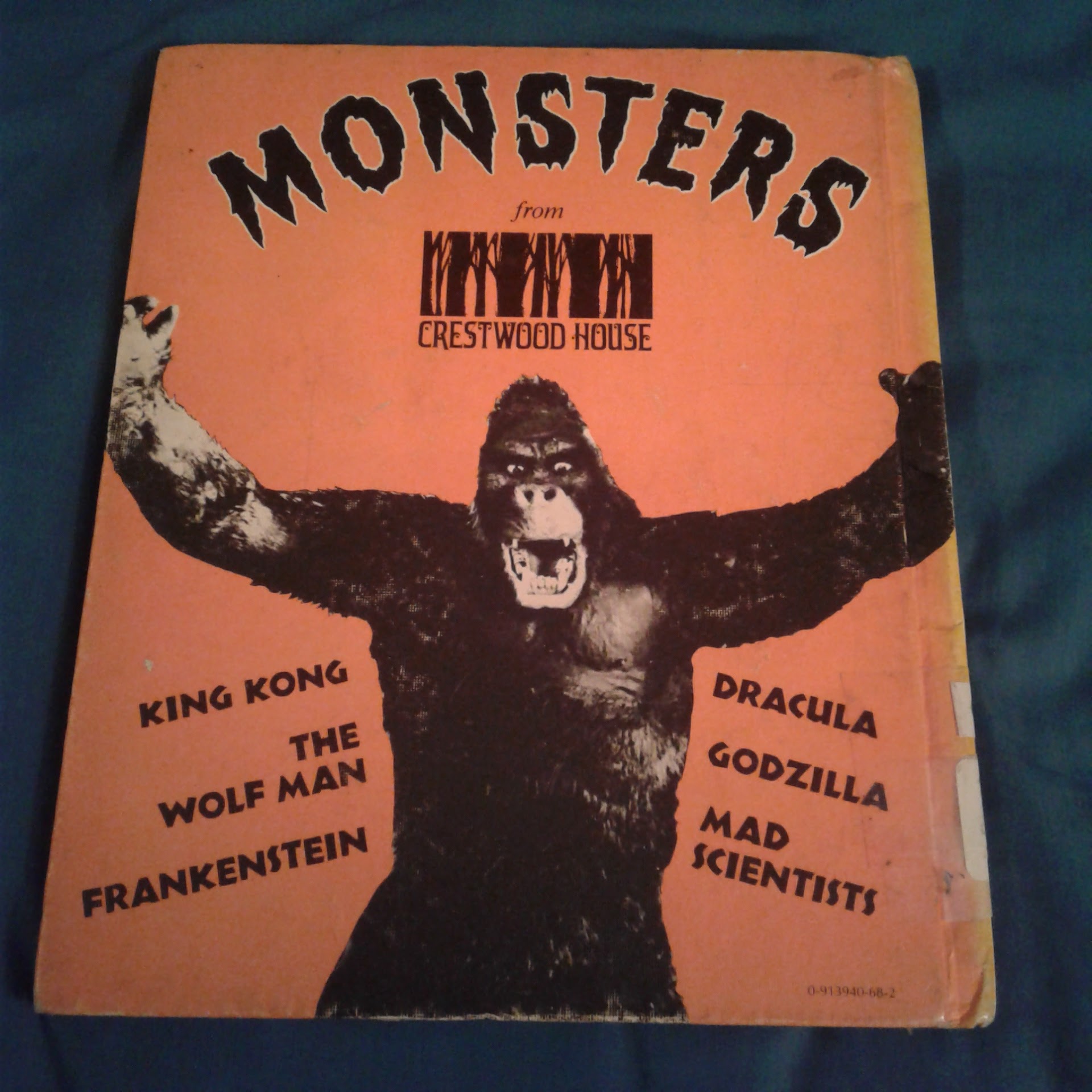
the Crestwood House Monsters series. This was a series of hardback books
released in the late 1970’s (and later reprinted in 1982) that revolved around
classic movie monsters. The books had a very striking design: a black and white
cover that featured the monster in question and their name in bold orange
colors, with a deep orange spine and an orange back cover (with the text on the
spine and back cover being in black). On the back cover one could find the word
MONSTERS in big black all-caps letters, and beneath that was the publisher’s
logo and a list of all of the titles in the series (beneath this list was a
black and white King Kong with outstretched arms). These books were credited to
Ian Thorne, which was a pseudonym for the science fiction writer Julian Clare
May, but their actual authorship is, as far as I know, unknown. Each of the
books in the series was around 50 pages long, and full of information on the
monster and their various film appearances, all illustrated with striking black
and white photographs. The titles in the series were The Invisible Man, The Deadly
Mantis, It Came From Outer Space,
The Phantom of the Opera, Frankenstein Meets Wolfman, The Murders in the Rue Morgue, The Creature from the Black Lagoon, The Wolfman, The Mummy, Godzilla, The Blob, Mad Scientists, Frankenstein,
King Kong, and Dracula. I forget if the Bernon Heights library had the complete
set… I don’t believe so as I don’t recall ever reading ones like The Deadly Mantis. Of the many books in
the library, these monster books were my favorite, and I was always taking them
out to read at home. Godzilla,
obviously, was my favorite of the bunch, but I also quite enjoyed The Blob and Dracula as well. This year I finally purchased for my own collection a used copy of the Godzilla book.


As for Dracula (a book I consulted when doing research for the role of a vampire that I was to act out in a school play),
the Crestwood book had a very atmospheric photograph of Bela Lugosi posing as the Count
on the cover (from the 1931 American Dracula movie), and though I enjoyed reading this book as well, I
would not actually see the Lugosi version of the film until the year 1999,
during my second year of college, when I became involved in the Goth subculture. But to get back to the Dracula book. It began with a lengthy
description of the 1931 Dracula film,
followed by some information on Bram Stoker and how he wrote the original
novel, biographical details on Vlad the Impaler and Elizabeth Bathory, a map of
Transylvania, a photograph of a real-life vampire bat, and briefer descriptions
of some of the other Dracula spin-offs and remake films, including Nosferatu, the Christopher Lee Hammer
Horror movies, even Blacula. This
book also gave some details on what vampires actually were: undead monsters
that rose from their coffins to feast on human blood, fanged reflection-less
creatures capable of turning into bats, that could be repelled by both garlic
or a cross and which could only be killed either by exposure to daylight or
driving a stake through their heart.
Another
book I consulted for research purposes was Gary Jennings’ Black Magic, White Magic (The Dial Press, 1964), an introduction to
occultism written for younger readers (what my school library was doing with a
copy of this book I have no idea). This book also had some information on vampires.
Here’s a direct quote: “The vampire was thought to be a corpse who refused to
stay dead, continuing to roam the earth. To sustain this unnatural animation,
it had to have human blood, which it drew from unsuspecting sleepers. In some
versions of the legend, the bite of a vampire could turn the bitten one into a
vampire, too.” It went on to say that Transylvania wasn’t the only location on
Earth that had vampire legends, but that many other countries had vampire
legends of their own (for example, the ancient Babylonians feared a
vampire-like creature known as the Akhkharu). Interestingly enough, on page 51
of this book there was an illustration of a pentagram, and an explanation about
how, when the pentagram was right-side up, it was a powerful protection against
the forces of evil, but when it was pointed downward, the symbol represented
Satan and was used to invoke evil spirits. My friend J was also a big
admirer of this book, and it’s no doubt that it was within its pages that he
came up with the idea to draw pentagrams on the palm of my hands to protect me
from his lupine ambitions: though evidently he had read the book wrong, what
with him drawing upside-down pentagrams on my hands instead (unless his
intentions were more malicious than I’m giving him credit for… and with J,
who knows? But that's a tale for another day...)
Despite
my many happy memories of hours spent at the Bernon Heights Elementary School
library, I do have some bad memories as well. Towards the back of the library,
near the south corner of the east wall, were a number of magazines and
periodicals, and some days when I was bored I would flip through these. Boy’s Life was one that I especially
seemed to enjoy. In September 1990, the month I began the 5th grade,
I was flipping through the August 1990 issue of that magazine. I’m not sure what the magazine’s like now but back then each
issue had a one page comic chronicling the real-life exploits of Boy Scouts
whose heroic actions saved the life of another: “A True Story of Scouts in
Action” was the name of this feature. In the August 1990 entry, the story
depicted in the comic is set in Utah and revolves around a 49 year-old man
named Ted Phillips. On August 17th, 1988, Ted was awoken by a sound
at 4:30 AM. Thinking it was one of his children, he went downstairs to
investigate the noise. Upon reaching the first floor of his house, an intruder
suddenly appeared, swinging a big hunting knife. As Ted was stabbed, he yelled
out to his wife to “get the gun!” The intruder then dropped the hunting knife
and ran away from the house. While the mother called the police, Ted’s 14
year-old son, Scott, administered first-aid to his father, who was bleeding. Luckily, he wasn’t hurt too badly and survived the encounter.

I’m not sure why, but something
terrified me about this story as a kid. Partly it’s due to the scenario of the
story, which is itself an contrivance of horror (in that someone’s reality is
invaded by an agent of irrationality, violence, chaos and unreality): it was a
situation I could easily visualize happening to myself, and the fact that the
‘Intruder’ is never named, has no speaking lines or any established motive for
why he’s breaking into someone’s house and stabbing strangers in the dark (and
by the end of the comic still remains at large) doesn’t help matters. But I
think what I found especially unnerving about this comic (which, when I looked
back on it in January of 2016, seemed somewhat tame) is how the ‘Intruder’ was
drawn: shadowy, seemingly bleached of most colors, with weird lines running
vertically not only down his clothes but also his face (perhaps drawn by the
illustrator to suggest shadows). And what was that thing atop his head supposed
to be: hair, some kind of hat, maybe a ski-mask he had forgotten to cover his
face with?
Anyway, it’s funny how this image, which
I saw for only a few minutes on one day of my life as a child, haunted my mind
for years. It was even more interesting for me to see it again (over 25 or so
years later) and see what I both remembered (and misremembered) about the scene.
In my memory of the comic, the scenario went like this: late at night, the
father hears a knock at the door. He goes to answer it, and on the other side
of the screen door is the ‘Intruder,’ who stabs him with a knife before
vanishing into the night. Obviously I got some of the key details right (a
father being stabbed with a knife in his house late at night by a stranger) but
some of the other details wrong (the stranger never knocked at the door, and it
wasn’t a screen door, but a sliding one). I see also that I totally
misremembered how the Intruder looked: I thought we saw his visage from his
front profile, not his side. But one thing I did remember correctly was how he appeared to look somewhat gray
and had lines running all along his body. That
I remembered accurately.
While on the subject, now might be a
good time to talk about some of the other books I enjoyed reading as a kid.
Unsurprisingly I was a fan of some of the standards, such as the Berenstain
Bears, Babar the Elephant (especially Babar
and Zephir; I loved the horned monster Polomoche and his fellow beasts the
Gogottes. Also worth checking out is Babar
and Father Christmas, which has a stunning two-page illustration of Father
Christmas’ sprawling and cozy
underground home/workshops), Dr. Seuss’ work, and Roger Hargreave’s Mr.
Men series (if I remember correctly, my two favorite characters from that
latter series were Mr. Bump and Mr. Daydream… maybe Mr. Dizzy as well). There
was also the Wayside School books written by Louis Sacher, James Howe’s Bunnicula series (Chester the Cat being
my favorite character from those), Nancy McArthur’s The Mystery of the Plant That Ate Dirty Socks, Daniel Pinkwater’s Lizard Music, Gary Poole’s Movie Monsters (Modern Publishers,
1986), Richard Meyer’s The Great Science
Fiction Films (Citadel Press, 1984), Christopher Finch’s The Making of the Dark Crystal (Holt,
Rinehart & Winston, 1983), The Star
Wars Storybook (Random House, 1978), Ten
Great Mysteries of Edgar Allan Poe (Scholastic Books, 1989… though I must
confess I was a little creeped out by the sinister illustration of Poe’s face
on the front cover), and so on and so forth. The Johnny Dixon horror mysteries
by John Bellairs were also books I loved, though I didn’t start to read those
until around the 5th grade, the first of which was The Spell of the Sorcerer’s Skull. And
who could forget Bruce Carter’s 1977 novel Buzzbugs,
with its striking cover art featuring two people, a man and a woman, running up
a hill and trying to escape from a mosquito the size of a whale?

One of my favorite books from that era
was Roald Dahl’s James and the Giant
Peach. I discovered that book when one of my grade school teachers read it
to our class, a few chapters every day. I forget if that was the 2nd
grade or the 3rd grade… most likely the 3rd grade, so
probably around 1987-1988. After she had finished reading the book to us I
managed to get a copy of my own, with beautiful illustrations by Nancy Ekholm
Burkert. Something about that book just captivated my imagination, and like the
little boy in the book I too wanted to live inside that giant peach, surrounded
by those big fantastic talking bugs (the Centipede being my favorite).
However, by
far my most beloved books when I was a child were the two Alice books written
by Lewis Carroll, Alice’s Adventures in
Wonderland and Through the
Looking-Glass. The edition I owned (put out by Watermill Press in 1983)
collected both volumes, though many of the illustrations by John Tenniel were
not included (I believe they only had one per chapter). I first read the book
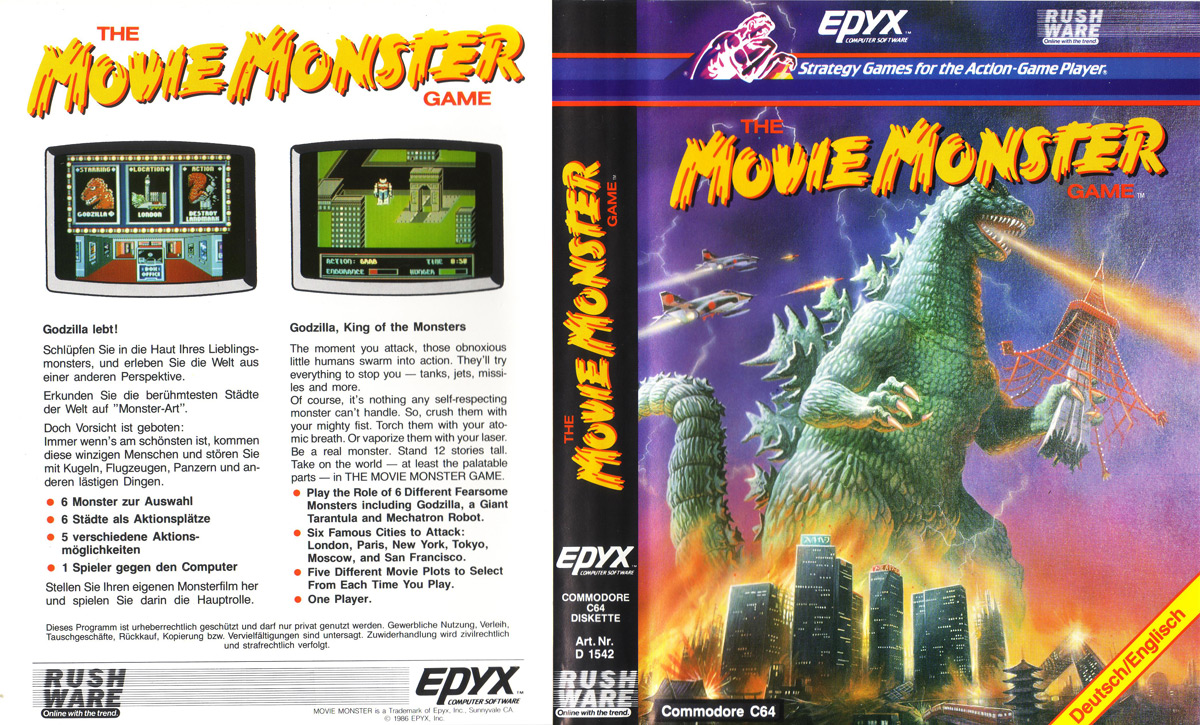
in 1986, the same year that the aforementioned Commodore 64 game was released,
though I can’t remember if I played the game first or read the book first… no
matter what, one of them inspired me to investigate the other. To this date I
still enjoy re-reading the Alice books every few years. My two favorite
characters from the first Alice book were the Cheshire Cat (big surprise there)
and the Gryphon. It’s perhaps no surprise that since reading that book the
griffin remains one of my favorite mythological hybrid creatures. But seeing as I hope to do a whole separate post on the Alice books at some future point, for now I will say no more on this topic.